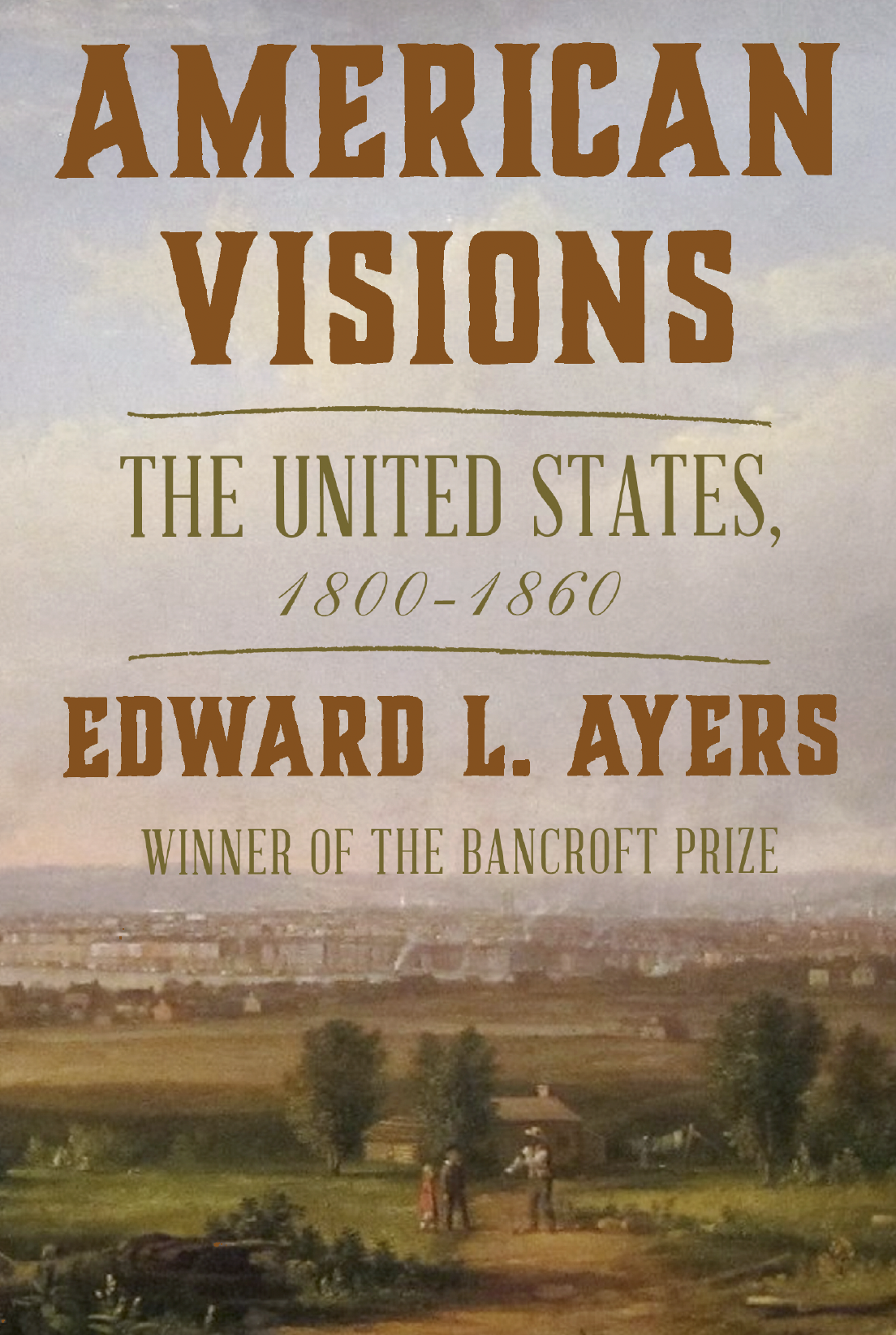
In American Visions, Ayers, one of our greatest scholars of the South and the Civil War, argues that to understand this nation readers must search for its roots in the period from 1800 to 1860, a time of enormous growth, expansion, and conquest alongside a surging slave society that put the entire country in peril. Ayers is a professor of humanities at the University of Richmond, where he also served for eight years as president. Originally from the South, he got his start in American studies during the 1970s, training under the cultural and intellectual historian David Brion Davis at Yale. One of Ayers’s early books, The Promise of the New South: Life After Reconstruction (1992), was a major attempt at a revision of C. Vann Woodward’s classic, Origins of the New South (1951).
Ayers brought a literary, cultural, and racial emphasis to understanding the transformations of the South of the 1870s–1890s, forged by commerce, railroads, black and white culture, and violence. Ayers has also been a pioneer in digital history. In the 1990s he created the website the Valley of the Shadow, an ambitious in-depth social history of two communities during the Civil War—Augusta County, Virginia, and Franklin County, Pennsylvania—that shared roughly the same ethnic background, landscape, and economy, except that one was a slave society and the other free. That project led to two prize-winning books, In the Presence of Mine Enemies: The Civil War in the Heart of America (2003) and The Thin Light of Freedom: The Civil War and Emancipation in the Heart of America (2017), as well as digital teaching resources that forever changed how the Civil War is studied.
“I am an optimistic person who has written and taught about the worst wrongs in American history—slavery, war, violence, injustice—for forty years,” Ayers writes in the preface to American Visions. “I have done so believing that by addressing those evils we can perceive and counter their insidious legacies.” Yet, he continues, it is sometimes hard to sustain that optimism when ugly scenes from the new United States reappear: nativists and racists march, apocalyptic prophecies and conspiracies proliferate, and religious faith is wielded as a political weapon. Those who would rule the United States with such purposes claim the sanction of history…. They seek control over history, expunging evidence of injustice in the name of national pride.
What Ayers offers readers is the opportunity “to remember a fuller American history, one that is more truly patriotic, one that evokes the nation’s highest ideals of equality and mutual respect in the face of the nation’s failings.” He does this by focusing on the “bold men and women” who, during the volatile period from Thomas Jefferson’s election to Abraham Lincoln’s, spoke without permission and often in defiance of those who held power…evoked humane understanding in speeches, novels, paintings, and songs…deflated pretension and hypocrisy…wrote with care of the beauty and fragility of the natural world. Their visions remain powerful—and necessary—generations later.
Each chapter of Ayers’s fascinating, wide-ranging book consists of a series of vignettes about presidents, former slaves, indomitable women, slaveholders, scam artists, religious eccentrics, Native American heroes, whalers, Mormons, and tellers of tall tales as well as great poets. His pages are populated with everyone from James and Dolley Madison to Johnny Appleseed, Frederick Douglass, and John Brown. He credits the journalist Margaret Fuller with giving to posterity the modern notion, in her 1845 manifesto Woman in the Nineteenth Century, that “there is no wholly masculine man, no purely feminine woman,” and thus women’s ambitions should in no way be limited. (“If you ask me what offices they may fill,” she wrote, “I reply—any…let them be sea-captains, if you will.”) At an event in support of the Underground Railroad, the freeborn Black poet Frances Ellen Watkins Harper read out her 1858 poem “Bury Me in a Free Land,” inspiring a listener to observe that “there swept over me, in a chill wave of horror, the realization that this noble woman…might have been sold on the auction-block, to the highest bidder.”
Ayers also dives into the stories of Native peoples who fought to resist white incursion into their lands and lives. Along with famous military leaders like Tecumseh and Osceola he includes writers and thinkers, among them Elias Boudinot, Sequoyah, and William Apess. Boudinot was born in Georgia to a Cherokee father and a white mother, and educated by missionaries in Connecticut, where he took the name of a Founding Father who supported their work. In the late 1820s he joined Sequoyah, the creator of the Cherokee writing system (and himself the son of a Cherokee woman and a white man), to document the Native struggle as a coeditor of the bilingual newspaper The Cherokee Phoenix and Indians’ Advocate. Andrew Jackson’s Indian Removal Act was soon passed—the policy that resulted in the death and displacement of as many as 100,000 members of the Cherokee, Creek, Seminole, Chickasaw, and Choctaw Nations. Apess, a devout Methodist and a descendant of the Pequot people and of white Christians in New England, implored his readers to find common ground in their shared religion, asking in his essay “An Indian’s Looking Glass for the White Man” (1833), “Did you ever hear or read of Christ teaching his disciples that they ought to despise one because his skin was different from theirs?”Ayers lingers on the great Romantic writers of the nineteenth century, often to moving effect. One of his book’s most remarkable passages describes the moment when Ralph Waldo Emerson received his copy of the first edition of Walt Whitman’s Leaves of
Grass in Concord, Massachusetts. It was July 4, 1855, and Emerson and his wife, Lidian, had draped their front gate in black bunting to protest the Kansas–Nebraska Act, which had been passed the year before and seemed to make possible the expansion of slavery to the entire West. The volume, with its “raised golden letters sprouting roots and tendrils,” contained what Emerson called “the best piece of American Buddhism that anyone has had strength to write, American to the bone.”
But for Ayers, no literary figure sums up the Union and the specter of its destruction better than Edgar Allan Poe, whom he admires for his “vision of men as vicious brutes, of women as pure and dying, of life as a battle between demons and angels.” Poe’s was a voice, Ayers suggests, that punctured the country’s myths of romance and progress: a reminder that, in a society that often pursued facile or pathetically material forms of happiness, some Americans also understood the darkness of human nature and the essential tragedy in history. Poe’s work is a reminder to readers that history is not clean, or linear, or automatic.
The transitions between the abundant vignettes in American Visions can be abrupt. Enough with literature, you might think—how did James Fenimore Cooper or Herman Melville help James Madison or Henry Clay figure out how to make “balanced” government work? But bringing together a large cacophonous cast seeking an illusive harmony is Ayers’s method of demonstrating that nations are always more than their political institutions and laws, and, hopefully, more than their most lethal divisions. The American nation was a primary subject for each of these writers, each in their own way.
Yet by the end of the 1850s, writes Ayers, America was living with a “broken politics.” “Fantasies of violence…filled imaginations,”“shared patriotism proved impossible to sustain,” and “no one could find the language to imagine a Union that was not divided.” Slavery increasingly tore apart political institutions as well as the social and cultural fabric. American Visions is a wild, sometimes frightful ride to the eve of destruction. The Civil War is out there on the horizon in this book, and its impending arrival is all the more tragic because of the cultural riches we have witnessed on the road to that horror.
“Dreams of Our Nation”, David W. Blight, New York Review of Books, June 11, 2026
American Visions is an inspiring book, promoting a sturdy sense of patriotism—one that, aware of the nation’s failings, remembers its “highest ideals of equality and mutual respect.” . . . American Visions beautifully shows how remarkably resilient dreams of a better republic remained even in the darkest of times. . . . The big-tent approach is also Mr. Ayers’s method. It is refreshing to encounter a book that gives equal billing to Stephen Foster’s “Oh! Susanna” and Nathaniel Hawthorne’s “The Scarlet Letter.” . . . . American Visions radiates nothing so clearly as the democratic spirit that drives Whitman’s poetry. Behind Mr. Ayers’s enthusiastic advocacy one glimpses, more strongly with each page, the outlines of that vast, truly equitable continent Whitman couldn’t stop dreaming about, a “land tolerating all, accepting all.”
Christoph Irmscher, Wall Street Journal
This nimble survey surveys the ‘visions’ that Americans fashioned for the nation taking shape before them in the ‘lurching’ period of 1800 to 1860. These ideals were expressed through literature, visual art, popular songs, political slogans, religious doctrines, and folk heroes . . . . The result is a dynamic portrait of a country in transition.
The New Yorker
In his eighth book, historian Ayers eloquently explains how “key elements” of American life, politics, and culture “crystallized” between 1800 and 1860. He describes a complex time crowded with people, facts, and events and veering “in unexpected directions.” Ayers succeeds in providing both detail and the big picture. . . . Ayers frankly describes the marginalization of and great harm done to women, African Americans, Native Americans, and immigrants. He also chronicles how men and women fought against these problems, some making positive change in their lifetimes, while others laid the groundwork for future reforms. Ayers' accurate, balanced, and compelling history proves that progress is possible and that patriotism can be rooted in the complicated truths about the past.
—Booklist
Available at your local independent bookstore and available for order
Audiobook version available at Audiobooks.com
Quisque iaculis facilisis lacinia. Mauris euismod pellentesque tellus sit amet mollis.